
OUT OF CONTROL:
A 15-YEAR BATTLE
|
|
|
12. CAN'T JAIL THE SPIRIT: 1988 CONTINUED |
|
|
In September we co-sponsored another event with the National Committee to Free Puerto Rican Prisoners of War and collected “Reflections on Five Years of Lockdown” from prisoners at Marion. Among the “Reflections” was the following from Oscar López Rivera:
The National Committee was initiating a human rights campaign around political prisoners held in the U.S. and forming a new group called Freedom Now. Steve and I discussed this initiative with the other members of CEML, and we all decided that although we completely supported such an initiative, our work was somewhat different. We wanted to continue our concentration on conditions faced by the mass of prisoners, political and not political, because we saw the criminal justice system as a racist mechanism of social control that had impact much more widely than only on political prisoners. We didn’t see ourselves at odds with political prisoners, in fact much of what we had learned about prisons came from them. But we thought it important to keep our more general focus. So we decided not to play a major role in Freedom Now. |
|
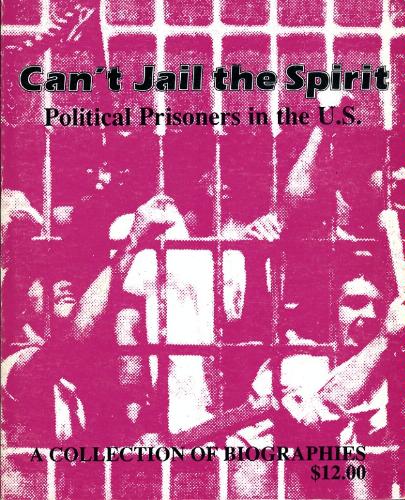
On the other hand, we wanted to make a contribution to the Freedom Now process. The members of the Committee to End the Marion Lockdown decided to work with Alejandro Molina of the National Committee to Free Puerto Rican POWs to put together a book of biographies of political prisoners. We would call it Can’t Jail the Spirit. It was a big undertaking for a small group of people who were already involved in lots of other work, but everyone we contacted helped facilitate the process and made it possible. We started by generating a list of political prisoners, combining lists compiled by the Center for Constitutional Rights, The Nuclear Resister (an anti-nuke newsletter), Breakthrough (the journal of the Prairie Fire Organizing Committee), and The Insurgent (the newsletter of the Committee to Fight Repression in New York). We added a few names that we knew about, then set about contacting each prisoner directly, or through his or her defense committee or lawyer. By going through these committees, we were sometimes able to acquire collections of biographical statements written or authorized by the prisoners themselves. In other cases, we assembled bios from previously published materials. Finally, many of the prisoners wrote to us directly. The first version of Can’t Jail The Spirit, photocopied at Kinko’s (where everybody knew our names) and stapled together, was rushed into print for our late October 1988 conference. We wrote to 117 political prisoners and 51 had a chance to answer us by our first deadline. We printed those bios along with a photograph when available, the address of the prisoner, and a request that people write. Essentially we were saying, “If the U.S. does not hold any political prisoners, then who are these people?” The first printing sold out within a month, and a very generous grant from the Prisoners of Conscience Project of the National Council of Churches enabled us to print the next edition which contained 15 additional biographies. This would be an actual paperback book with a preface by Reverend Michael Yasutake, and two forwards by José López and Dr. Nieves Falcón. Alejandro Molina designed an awesome cover of prisoners with their fists and arms protruding through the bars that caged them. Over the next 15 years we produced another four editions of Can’t Jail the Spirit, the last one in February, 2002. Financial assistance was often provided by Rev. Yasutake’s Interfaith Prisoners of Conscience group. The cover remained the same but with a color change each time—grey, brown, pink, green, and purple. Every new edition required labor-intensive work, as we wanted to be up-to-date, accurate, and reflect the prisoners’ desires. We also included a photograph of each prisoner and collecting them was a substantial piece of work. I took on that responsibility with Alejandro. It wasn’t always easy to get decent pictures from inside, but we thought it was important as part of an effort to humanize the prisoners. From one edition to the next, some prisoners were released and new people incarcerated. We tried as hard as possible to make contact with each prisoner to ensure that no one was included who did not want to be, and that each person had an opportunity to revise his or her biography if so inclined. Prisoners were often moved to other prisons and we had to make sure the addresses we printed were the most current, up to the moment we sent the book to the printer, since the prison system would not forward mail to prisoners. The editorial decisions, most importantly—who was a political prisoner—rested in the hands of different groups of people for each of the editions. One year it was Freedom Now; another it was Jericho, a later organization that fought for political prisoners. The final edition was edited by the leading member of Crossroads Support Network, Owusu Yaki Yakuba. For all editions, however, the grunt work was doing by members of CEML and Alejandro Molina from the National Committee. Once the content and layout were completed, our friends Don and Janene at C&D Press in Chicago would stay up late on many nights printing the thousands of pages to meet our deadlines. Then a group of us would collate the thousands of pages by hand, walking around and around big, long tables, usually at the Puerto Rican Cultural Center, until the process was completed and we were falling off our feet. The books would then be bound by a professional bindery, ready for sale at a substantial financial loss, as usual. (When working on this narrative, we googled Can’t Jail the Spirit and were amazed to discover that this book, which we laid out with our own hands and sold for $10 to $20, is now available on Amazon.com for as much as $55.95 and $3.99 shipping.) |
|
|
To Chapter Thirteen: We Confront the Head of Bureau of Prisons
|

The Freedom Archives * 522 Valencia Street San Francisco, CA 94110
Phone: (415) 863-9977 | E-mail: info [at] freedomarchives [dot] org